FAQs & Fees

Pic of the Columbia Heights office we can meet in. The couch is comfy, and I keep fidgets around to help both of us pay attention during session, and notecards for writing down anything you want to try to do for homework between sessions.
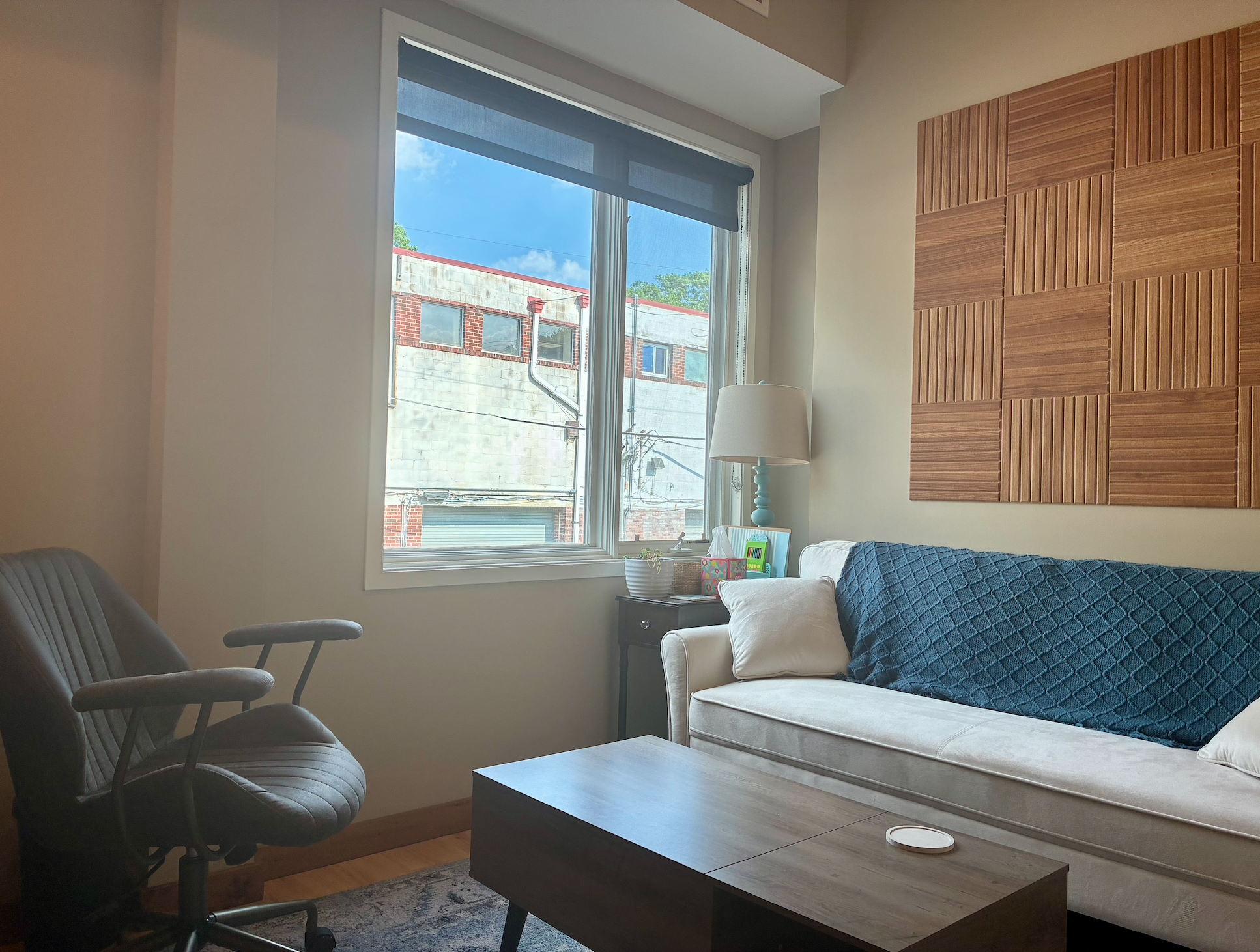
Pic of my Takoma Park Ave office, where there’s even more fidgets, notecards and colored pencils (if you like to draw / color during session). Parking is super easy.
-
Yes. We can meet online as long as …
You are physically located in DC, Maryland, Pennsylvania, or Virginia during our session.
You have a private space available with a strong internet connection.
We determine that meeting virtually is a good fit for your therapy goals.
-
Yep, I have in-person time …
Mondays and by appointment - Dandelion Collective in Columbia Heights (on the green line in DC)
Wednesdays and by appointment - Takoma Park, Md close to the DC border
I will share the address if we are scheduling an in-person appt. Caveat: these offices are in older buildings, and do require traversing 1-2 flights of stairs. If this is a barrier, we should plan to meet virtually.
-
I typically meet with new clients on a weekly basis for a few sessions, and then we decide together how often we should be meeting to make progress towards your goals. While this is weekly for most people, I do …
meet with some folks more frequently if my schedule allows (especially if it is challenging to complete homework outside of session, or could use more support in stabilizing after completing a Higher Level of Care, such as an intensive outpatient program or an inpatient hospital stay)
meet with others 2x/month. This is typically for clients whose mental health challenges are no longer interfering with their functioning at work or at home, or are ready to practice using more skills on their own between sessions.
I do not meet with people less than 2x/month, unless we are preparing to end therapy after much progress (yay) and are intentionally and slowly moving in that direction. Folks can and do come back to regularly scheduled therapy with me if a problem has resurfaced, or if something new has come up.
-
Session fees as of November 2025 are:
Intake session (CPT code 90791) - $200, typically 50-70 min
Ongoing sessions (CPT code 90834) - $185, typically 45-50 min
Disentangle group class for OCD (CPT code 90853) - $80 per session, billed in 6-week cycles for $480 (please note that sliding scale is available for this group, please enquire for details).
Session fees increase yearly.
-
I am an Out of Network (OON) provider with all insurances, which means that payment will be charged at the time of services. I will provide a superbill in your client portal for any sessions we have, which you may choose to submit to your insurance company for reimbursement of services.
Please read on in the questions below for more about the reimbursement process and affordability.
-
If you have a PPO/POS plan, you may wish to ask:
How many sessions can be covered per year?
What reimbursement is available for intakes (CPT code 90791), individual sessions (CPT codes 90837, 90834) and group sessions (CPT code 90853)?
Do different diagnosis codes have different stipulations for how many sessions can be covered? (example: GAD is F41.1, adjustment disorders F43.2, please ask Emily if you would like to know yours)
What is my deductible? Do I need to meet my deductible before I can be reimbursed for sessions with an Out of Network (OON) provider?
How do I submit a superbill?
-
Select an insurance plan that has out-of-network benefits for mental health care during open enrollment, or during any significant life change that allows you to change insurance plans (such as changing jobs). These are typically PPO or other non-HMO plans. HMO plans generally do not cover Out of Network (OON) treatment.
If you can only afford an HMO plan, or if you want to try to get higher reimbursement from your PPO/other plan, you may be able to seek a special exemption (often called a network gap exemption or a single case agreement) if you have a more unique disorder (such as OCD or an ED, or several co-occurring disorders), as there are very few providers who take insurance on an in-network basis and treat these conditions (even more so in DC than in Md/Pa). You can learn more about this process here:
Getting your insurance company to pay for out-of-network treatment:
-
If you live in Maryland, recent legislation says that most private health insurance plans (ie, not Medicaid) should cover services with out-of-network providers if an in-network provider does not have availability within 10 days. (Read more here: https://www.mdcoalition.org/if-you-have-private-health-insurance-you-need-to-know-about-this-new-law/ .) If you’ve been looking for an in-network with provider with no luck, I strongly encourage you to
learn your rights (see above),
document who you’ve reached out to, and how long of a wait it would be to be scheduled (if you were offered an appointment at all),
advocate for yourself with your carrier - follow the instructions at https://insurance.maryland.gov/Consumer/Pages/Commercial-Carrier-Process-to-Request-a-Referral-to-a-Specialist-or-Non-Physician-Specialist.aspx .
-
I offer sliding scale spots in my group class, Disentangle, which treats OCD. Please email me at emily@emily-star.com to learn more about the next cycle of this class.
I offer individual pro-bono services for Maryland-based clients via https://www.probonocounseling.org/. As of July 2026, these slots are full.
Good to know in-network options (ie you would likely just pay your copay for services, or qualify for free services):
in Md and DC, Mary’s Center offers many behavioral healthcare programs, including individual therapy and psychiatry services
For queer folx in DC, Whitman-Walker has individual and group therapy (this is listed under behavioral health at https://www.whitman-walker.org/health-services/behavioral-health/), for folks who enroll in primary care services, as well as same-day walk in services